The fourth edition of Consciousness: An Introduction, the world’s only textbook on consciousness, came out in April 2024.
Our intention with this textbook is to introduce our readers to the mystery-filled world of consciousness research by encouraging you to think through the core problem and the big (and little) questions from the ground up—setting aside as many of your assumptions as you can, so you get to have the fun of having new insights and treading new paths.
Where to explore/buy
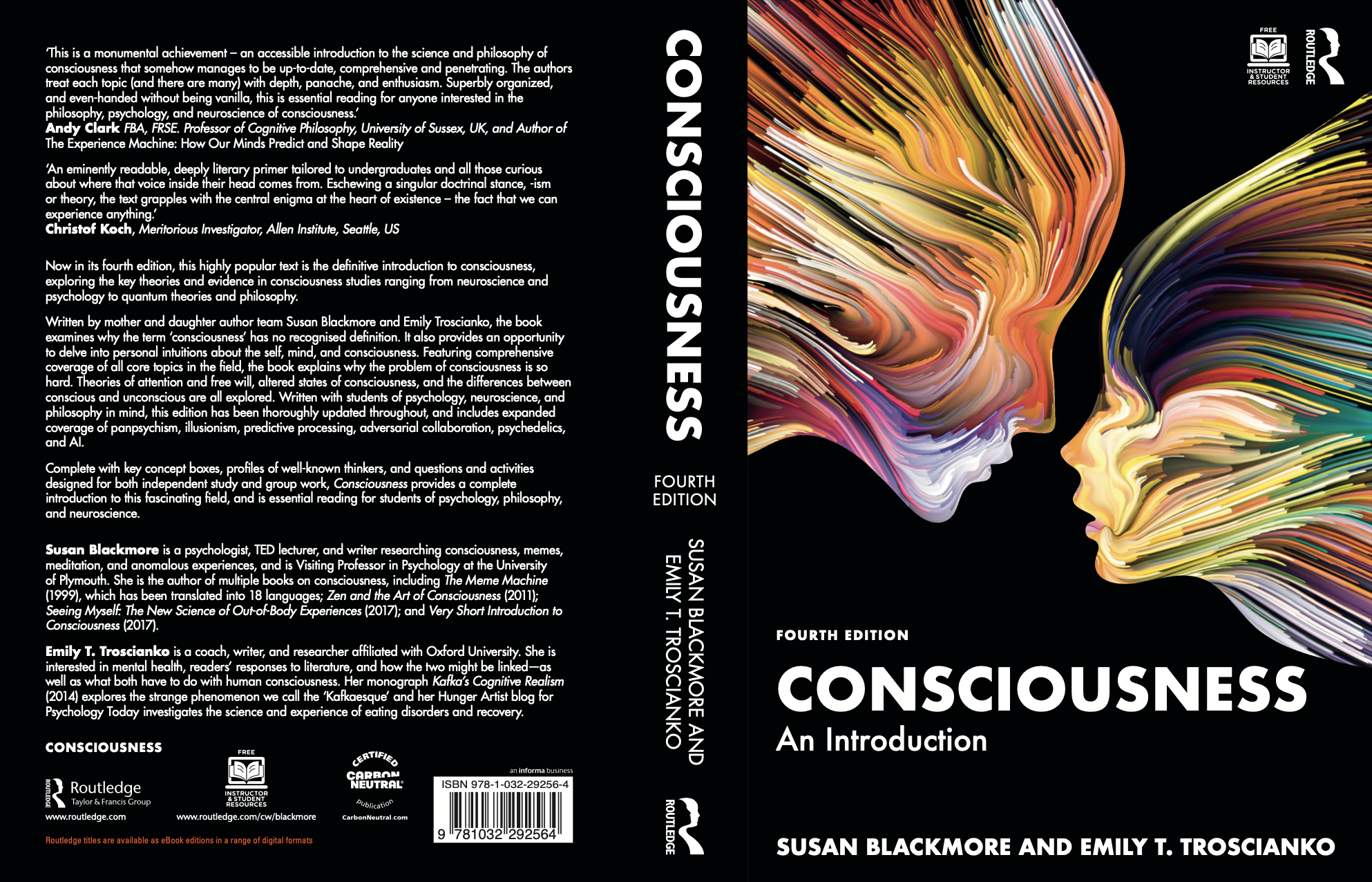
The book is available in paperback, hardback, and ebook formats. You can:
Preview and buy it from the Routledge website (contact me if you’d like a 20% discount code to buy it from here rather than Amazon)
Preview and buy it from amazon.co.uk or amazon.com (we’d much appreciate it if you could leave a review, too, once you’ve read a bit!)
Find out more on the companion website.
The companion site includes videos that Sue and I made about the writing of the book in Madeira, as well as tips on how to use it and many suggestions for further reading, watching, and listening.
Table of contents
The ToC gives a sense of the vast scope of what’s covered in the book itself:
Section One | The problem
1. What’s the problem?
2. What is it like to be…?
3. The grand illusion
Section Two | The brain
4. Neuroscience and the correlates of consciousness
5. The theatre of the mind
6. The unity of consciousness
Section Three | Mind and action
7. Attention
8. Conscious and unconscious
9. Agency and free will
Section Four | Evolution
10. Evolution and animal minds
11. The function of consciousness
12. The evolution of machines
Section Five | Borderlands
13. Altered states of consciousness
14. Reality and imagination
15. Dreaming and beyond
Section Six | Self and other
16. Egos, bundles, and theories of self
17. The view from within?
18. Waking up
The backstory
The first and second editions were my mother Sue Blackmore’s creations (back in 2003 and 2010), and she couldn’t quite face the task of updating it again alone (I have no idea how she ever dared create it alone in the first place). One afternoon in Oxford in the summer of 2014, we seemed simultaneously to arrive at the idea that the two of us might collaborate on the third edition, and just shy of four years later, it finally materialized.
The process of creating the third edition was long-drawn-out in the way that writing projects always are when you don’t carve out proper time for them. So for the fourth, we learnt our lesson and I said I’d only do it if we took a winter month away from everything else, somewhere warmer than England and with a pool, and get the bulk of the work done in one go. Airbnb’s “amazing pools” filter took us to a spectacular clifftop on Madeira, and every day of January 2023 except Sundays, we dove into the updates (and the 12-degree infinity pool!) and did our best to reflect the intervening six years of progress in fields as diverse as AI, predictive processing, and psychedelics.

A little over a year later, it was very satisfying to bring 20 brand-new copies to the 2024 Science of Consciousness conference at Tucson and find readers for them!
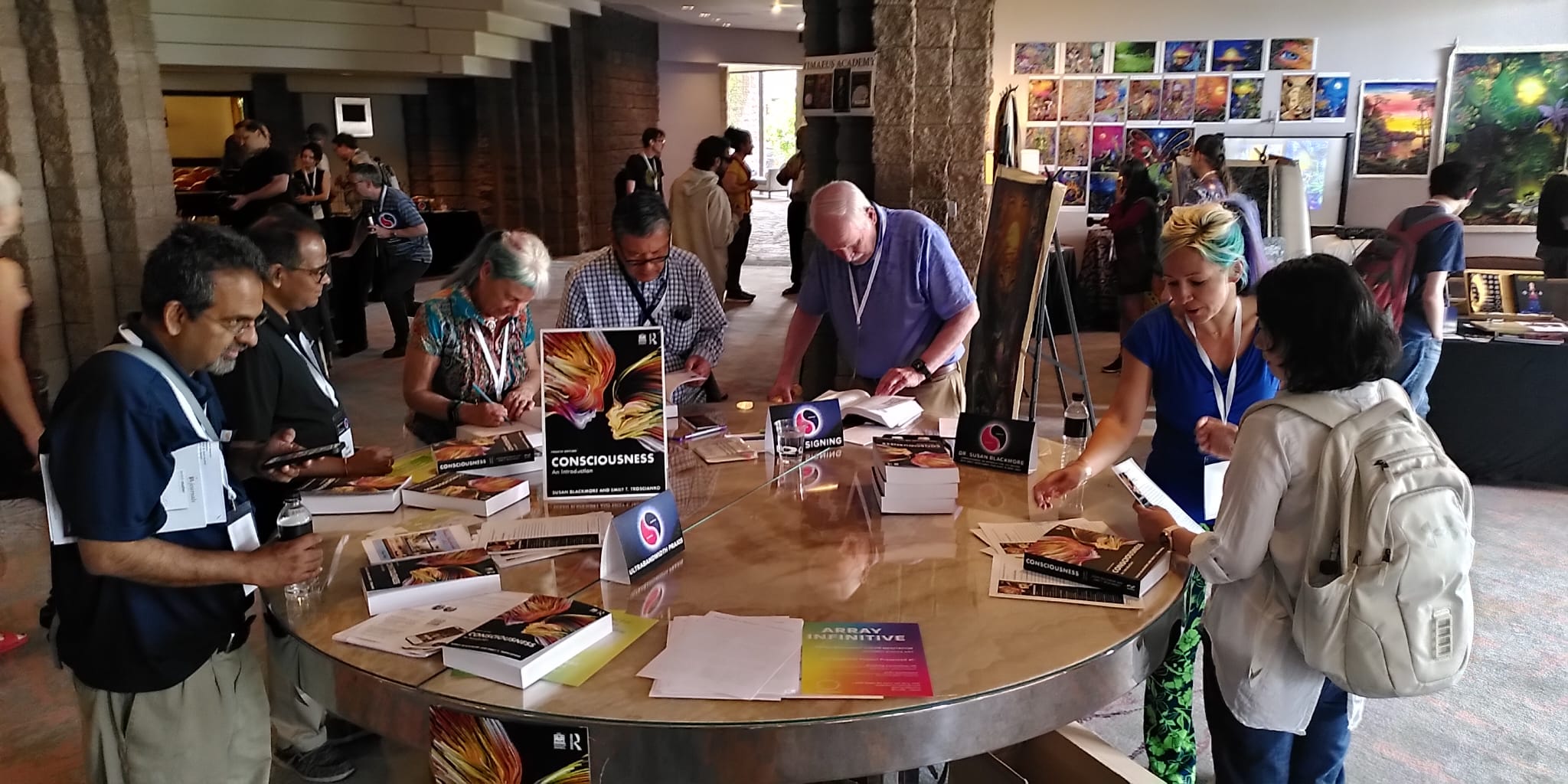
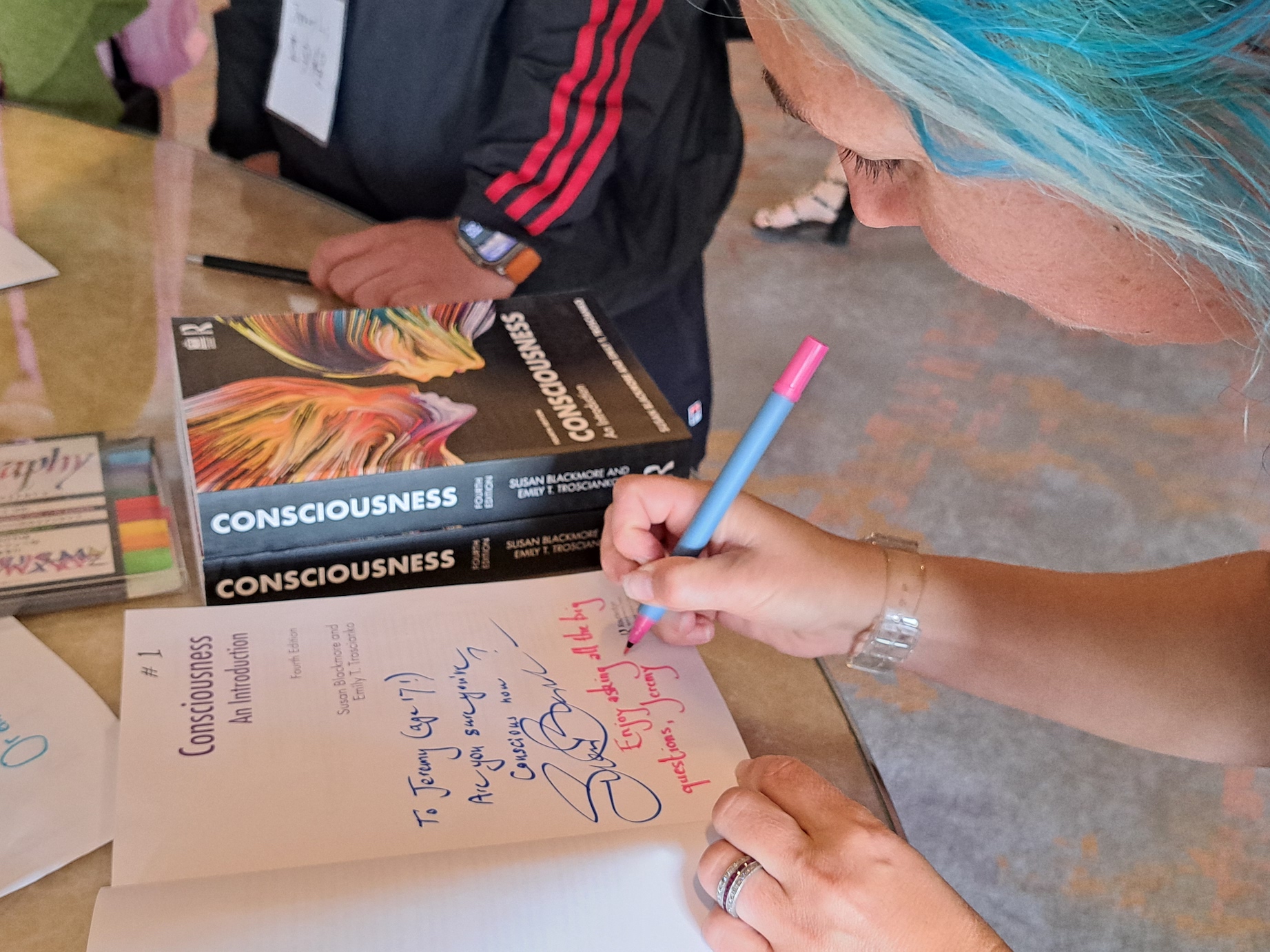
Here’s a short video of us having fun talking about the book and the conference with Nick Day, who does all kinds of fun TV for the Tucson conferences.
And here’s a rather nice review of the fourth edition from the July 2025 issue of CHOICE (Vol. 62 No. 11):
In this fourth edition of Consciousness: An Introduction, Susan Blackmore (Plymouth Univ.) and Emily Troscianko (Oxford Univ.) run the gamut from A (artificial intelligence) to Z (Zen Buddhism) in 766 pages that are both reader-friendly and entertaining. Their book is multi-disciplinary in nature, drawing from anthropology (Yanomami shamanism), neuroscience (split brain research), psychiatry (Freudian and Jungian concepts of the unconscious), phenomenology (“the hard problem”), philosophy (“free will”), zoology (gorilla consciousness), history (da Vinci’s treatise on the eye), linguistics (the entomology of ”psychedelics” and “psychonaut”), literature (Dr. Jekyll & Mr. Hyde), psychology (the “flow” state; the “hidden observer” during hypnosis), psychopathology (PTSD), and psychotherapy (psilocybin-assisted therapy). The text is enlivened by activities (how to meditate), concepts (measuring consciousness), profiles (Patricia Churchland Smith), further reading, and cartoons. Various sides of controversies are fairly stated, such as the diverse definitions of “consciousness,” and the evolutionary purpose of dreaming. The authors take a skeptical but knowledgeable perspective on out-of-body experiences, near-death experiences, and parapsychology (although crucial meta-analyses supporting the ESP hypothesis are omitted). No matter how much readers think they may know about consciousness, they will discover something new in this book. I certainly did!–S. Krippner, California Institute of Integral StudiesSumming Up: Highly recommended. All readers.
Third edition
If you’re interested in the backstory, there are a few things on the third edition that might still be fun/useful.
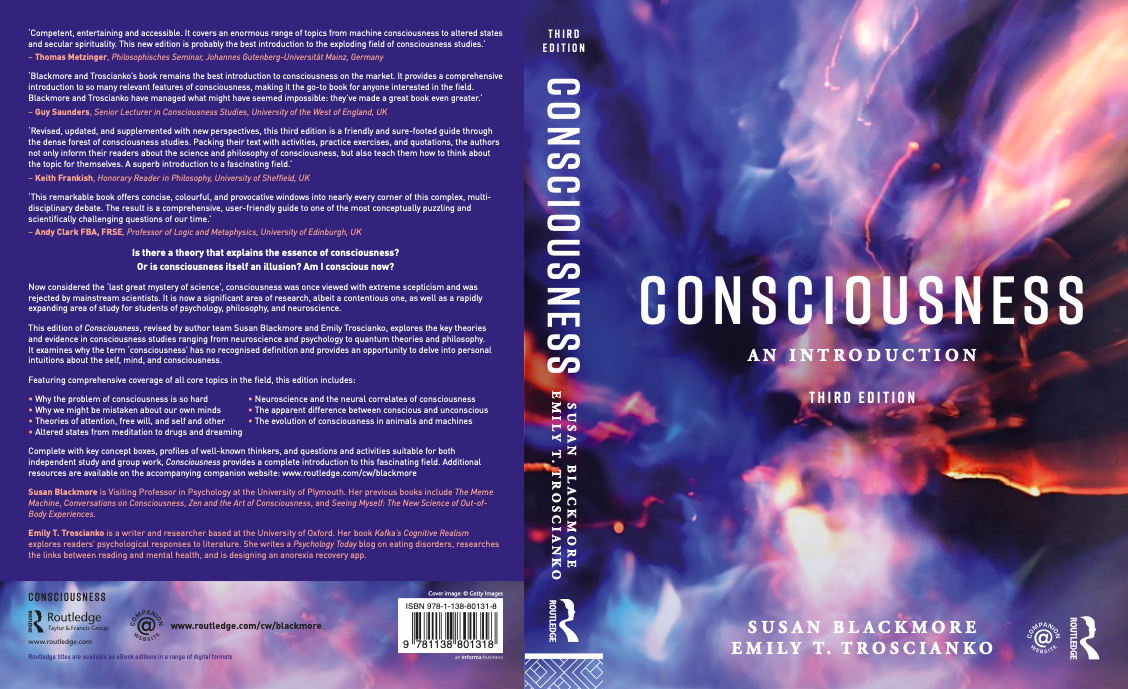
Here’s a video of Sue and me talking to Adam Hart-Davis (her husband, my stepfather!) on how the third edition came about:
And here’s a review by Nick Chater. (As well as our review of his 2018 book, The Mind Is Flat [see the PDF preprint here].)
More to watch
If you want to get a taste of Sue and me doing other consciousness-related things, here are a few videos from the Science of Consciousness conference at Tucson in 2022.
First, our talk on “How and why to teach consciousness”, complete with gruesome baby doll and furry lobster. (We’re the first 30 minutes.)
Second, our interviews with Nick Day for Consciousness Central, filmed at the conference. (Contrary to appearances in the thumbnail, Sue is the first 15 minutes, and I’m 7 minutes from 25:21.)
Third, the interesting debacle that was Sue’s “dialogue” with Deepak Chopra.
 Emily T. Troscianko