I offer work/life and writing coaching, primarily online and occasionally in person. (I currently split my time between Oxford, England, and Santa Barbara, California.) I work mostly with individuals who are or have been on an academic career trajectory, at any stage from undergraduate to full professor, on everyday ways of working and living, on career transition, and on specific projects like books, dissertations, and grant proposals. I also work with authors and others wanting to make writing a more substantial part of their day-to-day reality. I draw on my own partially-academic career as well as my expertise in mental health, academic skills training, and academic editing to help you work out what isn’t working for you, and then fix it—for the good of the projects you care about, as well as your career trajectory and your life.
For a quick overview of my work/life coaching service, see the PDF factsheet here. If you have questions, or to book your free 30-minute discovery call, please reach out via my contact form, or email me at emily [at] troscianko.com. Or you can join my waiting list directly by completing the form here.
If you’d like to listen, here’s a little overview of how I might be able to help you.
Or read on to find out more…
What kind of coaching is this?
Good professional coaching is like good relationship counselling: It’s agnostic about the outcome, other than that it be good for you.
I used to think of the professional coaching I offer as “academic coaching”. But actually it’s work/life coaching that just often happens to take place within an academic context, and often has writing as one of its focal points.
So if you + academia (or whatever other sector you currently work in) feels like a marriage (or a love/hate relationship) that’s in need of some serious work, then it’s crucial that you impose no requirement that you stay together—or stay together in any particular configuration. If you work with me, I won’t either. In professional coaching it’s actually simpler than with relationships, because there’s only one of you to worry about. (It’s happily not my problem how your university will replace you if you leave, for example, and nor should it be yours.) But as in any sphere of life, finding real answers requires really bringing everything onto the table. In the professional sphere, that means not presupposing that your career has to take any particular route. That’s why, although I’ve done this kind of coaching most often with people currently working in the academic system, I now prefer to call it professional coaching rather than academic coaching.
Academia has a spiky cost/benefit profile. I’ve explored some of its contours, and ways of navigating them, in this series on resilience for the Oxford/Cambridge careers blog. Because of how our school lives often give way seamlessly to a university existence, guided by people who have by definition been successful in this realm, we tend to be sold the benefits of academic life a lot earlier than the costs become apparent to us. The academic lifestyle often promises more than it delivers—and it can be easy to ignore or downplay that fact, to our detriment. Yet the intellectual freedoms it offers are great, and the feeling of contributing to something big and meaningful can be too. So it’s natural and right to feel some ambivalence—maybe even some painful and frightening kinds of doubt—as you ask career questions for your own life.
Ambivalence is good when it gets you asking questions—and looking for answers. It’s good when it’s part of what brings you to make choices—with your eyes open. Helping you make open-eyed choices is what I understand as one of the major purposes of the professional coaching I offer.
And if academia isn’t your context but you want thoughtful + action-oriented input on anything relating to getting your day-to-day life feeling calmer, more meaningful, more you, then my kind of work/life/writing coaching may be right for you too. We can work out together, for example, how you’re going to get that book written this year (without forgetting to ask why you really want to, and whether this particular book is the right fit for your why) and enjoy making it actually happen. Or we can start from the lifestyle question rather than the output question, asking what kind of days you want to be living in this phase of your life and figuring out the non-mysterious steps that will make such days (and all the other good that will flow from them) your norm. The point is not to shy away from the difficult but extremely interesting questions about what you truly want and why, and to trust that the answers to them, and the practical consequences of those answers, will emerge once we look at them head-on.
How exactly can coaching with me help you?
There are some things I can help you with and some things I definitely can’t. Here are the main ones.
Things I can help you with:
Making a success of your career in a way that doesn’t compromise your health or happiness—indeed, in a way that enhances both.
We can do this via methods like:
- Mapping out your current career possibilities within and outside academia (or one foot in, one out), so you have confidence that what you’re doing is chosen, not assumed to be your only option (which is a great foundation for exploitation and resentment).
- Systematically articulating your personal and professional priorities at the interlocking levels of tomorrow, this week, this term/quarter/semester, this year, and the next 5 and 10 years. Exploring the contradictions and complements between the personal and professional and how to optimize them.
- Getting your everyday routines great, including with respect to the vital and often overlooked realities of what actually happens when you ”sit down to work”.
- Enhancing your capacity to perform the most important-to-you activities, such as writing, so your habits are as good as they can be for the things that matter most (not the ones that other people try to tell you are most urgent).
- Reimagining your research agenda—if you’ve lost your way research-wise, I can be your conversational sparring partner to help you find out what versions of next year’s grant proposals and publications will shape your next phase (and change the world) the way you want to.
Making the transition to a new type of career, whether alt-ac or non-academic, both smooth and exciting.
Here I have particular expertise in shifts from academic roles to fully freelance or portfolio career models, but I may also be able to help you in researching and preparing for non-academic employment.
- Again, scoping out your options is a crucial step here, and we’ll do this with tried and tested structures for identifying your skills, values, and viable futures.
- We’ll attend to the day-to-day pragmatics of both this transitional time and the way of life you’re building for your medium- and longer-term future.
- If you’re keeping some academic activity in the mix, whether paid or not, we’ll map out how to keep the right stuff in your schedule (and say firm no’s to the rest) so that staying research/teaching-active gives you the payoffs you want.
Honing your writing skills and habits, for any kind of text.
90% of writing well is creating conducive conditions in which to write well, so we’ll get your writing-related routines feeling and functioning excellently, via strategies like:
- Redesigning any elements of what precisely you do when you “sit down to work” that may not be serving you as well as they could, including session length, goal-setting, breaktime activities, your working environment, and defences against distraction and the myth of multitasking
- Ensuring that your morning and evening routines are strong and beautiful supports for a working day with real creativity in it
- Exploring your attitudes to writing—transforming those that are unhelpful and protecting those that help, using behavioural experiments and other methods
Powerful daily routines are less powerful if you have no bigger-picture clue what you’re doing, or if you feel constantly scattered between too many projects. So to get the project level of your writing life well organized, we can use tools like:
- Priority sorting templates, including metrics for urgency, importance, and other dimensions of value
- Full project review, to make explicit what’s done, what still needs to be, and in what order to tackle it to get your current projects from here to finished
- Calendar overview, for the timeline of a major project (e.g. book or thesis/dissertation) or for getting your writing term or year mapped out
- Milestone creation, so you have pre-deadlines (involving other people!) to keep you on track and generate feedback
- Multilayered goal-setting and review, to create plans, track progress, and review outcomes at the nested levels of project, week, day, and/or session
- Defences against email, admin, and other things that use apparent urgency to disguise themselves as important
And finally, there’s the writing itself! We can test out techniques for galvanizing the creative process, and spend time with the sentences you’re creating, for example via:
- Writing review sessions to discuss a piece of your writing in depth, including your rhetorical intentions and decisions at all levels from single word to superstructure
- Annotated editing, where I edit a sample of your writing, providing explanations for my changes and suggestions
- Adaptable templates and tools to help you take up new perspectives on your project (or a subsection of it), including (in academic pieces) to generate good research questions for the next phase
- Ways to make writing feel less like (the difficult kind of) writing—I find that many variants on talking can work wonders!
I love what a powerful tool for thinking writing is, and I find it extremely satisfying to help thoughts grow clearer thanks to a solid bit of writing-habit redesign.
Building a thinking partnership to help you have more and better ideas and do more with them.
Maybe you’re at a phase in your career where you want to be giving your intellectual creativity all the help it can get. You might be writing your first book or a book in a new genre, or applying for bigger grants than you have before, or simply feeling that the way you write papers has got a little stale or that there are cognitive capacities in you that aren’t quite getting realized.
We can do good things here with a selection of the tactics outlined above, geared to paying particular attention to what factors help and hinder creative thinking for you. (These might be psychological, bodily, environmental…—and they’re all malleable!) But the emphasis here will be giving plenty of time and space to exploring your ideas themselves. We can do generative back-and-forths in conversational form and/or by way of comments on drafts. Depending on your field, I may be able to ask questions and give prompts informed by some amount of subject-specific knowledge (e.g. to varying degrees, literary studies, health humanities, experimental psychology, clinical psychology, consciousness studies, neuroscience…). If not, I’ll do so furnished with broader-brush intellectual instincts about where your argument seems haziest or where there’s something intriguing that might be worth zeroing in on—or whatever I feel you need to give these ideas the best possible chance of coming to life.
There’s no hard dividing line between this type of thinking partnership and coaching oriented to behavioural change; both are about getting things to happen differently and better in ways you care about. But in this variant, you’ll probably be doing things at quite a high level in your professional practices, and we’ll have the luxury of focusing primarily on the fun of ”how do we get these ideas to really fly?”.
Things I can’t help you with (well, mostly one big thing):
Pursuing academic (or other professional) success to the detriment of your health (or happiness), as I see it.
You may disagree with me, but if I think you’re harming yourself, I can’t (and won’t) encourage and perpetuate that. The academic world can be brutal, and I’m in the business of helping people flourish within and beyond it, not helping it get away with things it shouldn’t. If I think there’s a problem that needs addressing, I will say so and we can have that conversation.
How does it actually work?
The coaching I offer has a shape and a rhythm to it. First we have a no-strings half-hour discovery call in which we establish what you want and need and whether my approach is right for you. On the basis of our conversation (and if I’m confident that I can help you achieve your aims), I’ll put together a proposal outlining how I understand your current goals and making suggestions for how we might best work together format-wise, so that you can decide whether you’d like to work with me. Typically, I’ll suggest at least one 4-week block of coaching; if you know you want more sustained support than that. I can design an 8- or 12-week program that may have a range of intensities to it. Occasionally I offer one-off sessions with well-defined aims, but typically I ask for a 4-week commitment, because 4 weeks is long enough to make changes that are both meaningful and sustainable; anything less than that doesn’t tend to be. I’ll ask about your preferences for the frequency for our Zoom sessions (or in-person sessions if we happen to be in the same city and you’d prefer that format) of 45, 60, or 75 minutes, and about what you imagining being helpful between sessions, including email or shared-doc check-ins, audio calls, weekly reviews, and other forms of contact to suit your needs, preferences, and budget. Although clients may progress to a lower-intensity format in which we’re meeting for sessions without any other contact in between, for the initial 4 weeks I’ve learned that having other supports between sessions—especially the ever-powerful weekly review!—makes for the most reliable and exciting kinds of change.
Before our first session, you’ll complete 1) an activity-tracking exercise to generate some unfiltered data about your current reality plus 2) a reflective exercise to get clear on what exactly you’re doing here and why, including goal-setting at three powerful timescales.
Then we’ll probably spend our first session digging into the details of your life and work right now, in order to work out two crucial things:
- which specific changes that you could make would do the most good (in terms of kicking off sustainable progress towards your end goals);
- which are actually feasible for you right now.
By the end of our first session, you will know what you want to be different by the end of this week and this month, and you will also know exactly what you are going to do this afternoon, or tomorrow, to start making these desires a reality.
Then we’ll be in touch regularly on whatever schedule we’ve agreed, to check that things are going to plan, whether that’s by you sending me a nightly email update on how the day went, or with a phone call every couple of days, or with light-touch app or shared-doc check-ins, or some combination. The weekly review—which we might do sometime at your weekend to start your calendar week strong, or at the end of our coaching week to prepare for our next session—is a place where I create a set of questions chosen to help you reflect as valuably as possible on the past week and to plan meaningfully for the week ahead. Depending on what we’ve agreed, I may then offer comments and questions on your answers to help you deepen the learning.
This structure creates momentum and overview for you and me, it gives us both confidence that what you’re doing makes sense and is achievable for you, and it allows you to devote your energy and attention to the everyday changes that need making, so you can hopefully also enjoy the exhilaration of making them.
Your initial 4-week program will likely include many of the following elements.
Getting started:
- Structured assessment of your professional and personal status quo
- Reflection on your reasons for seeking out coaching and how you want to be thinking and feeling and what you want to be doing when this phase of change is over (and at two timepoints leading up to then)
Our regular sessions:
- Laser-focused identification of where and how we can most powerfully intervene, right now, to get powerful cascades of change in motion
- Detailed planning to give us both confidence that what you decide on can and will actually happen
- Design of tailored experiments for changing behaviours that are preventing your life and work from being as good as they could be—complete with explicit predictions and the right measures, so we know what the stakes are: if you do x for the next 7 days, what are you expecting to be different by next Tuesday? (or alternatively, what are you sceptical could ever be different but willing to be proven wrong about?!)
- Targeted demolition work on patterns of thinking and feeling that are serving you badly
- Explicit learning from what goes well and what less so, to help us efficiently build up a bank of knowledge about what works best for you
Other contact between sessions:
- Near-realtime opportunities to reflect together (via calls, emails, voice notes, or shared docs) on what happened yesterday or today and how to tweak the details to get things even better—as well as troubleshoot efficiently, and avert crises before they occur
- Tailored shared documents and spreadsheets (if you’re a spreadsheet kind of person) for recording and learning from your activities and achievements
- App check-ins to keep tabs on a selection of the most important habits you’re building (or eliminating)
- Regular reviews to assess your progress and adjust our strategies where needed
Resources I’ll create and adapt for you to make sure the process of change you’ve embarked on proceeds clear-sightedly, and as swiftly as is right for it. These might include things like:
- daily or project planning guides and templates tailored to individual starting points and priorities
- bigger-picture review structures (e.g. how to have a great summer; roles and goals mapping; zooming out to different life levels)
- journaling prompts to help with everyday reflection and insight building
- guides for transforming negative attitudes or getting started, and for more writing-specific techniques and project types
- behavioural experiment design templates to test out competing hypotheses about alternative options
- tools for prioritizing amongst competing projects
- guidance for designing and managing freelance and portfolio careers
Together these kinds of structure have the potential to change a lot, pretty quickly, by helping habits be cultivated, skills be developed, and questions be answered. I introduce materials and ideas only if and when they’re needed rather than imposing big complicated sets of resources just because I like them. And I always look to your self-knowledge first, when working out how to tailor our coaching to what you need and how you prefer to work.
If there’s one quick way to summarize what all this helps you do, it’s making a habit of zooming out to see the big picture, and then zooming back in again—to connect what you discovered when you took that longer view with what you’re doing right now today and this week. Without the skill and habit of joining the dots between what’s happening now and what you want to be happening in 1 year or 10 years from now, those futures of yours are unlikely to be nearly as wonderful as they could be. (If you want to read more on zooming out, I’ve explored its importance to recovery from an eating disorder in this blog post. Lots of the principles generalize beyond that context.) Everyday busyness and stress are great at preventing this cognitive flexibility and connectedness from developing, and one of my roles as your coach is often to help you become expert at it. This kind of expertise will bring you confidence, calm, and happiness for the rest of your life.
What makes this different?
I’ve had various forms of therapy, counselling, and coaching myself over the years. When I compare the processes involved in those forms of support with what I now offer to others, there are clear contrasts. Many of the differences revolve around how it feels to have a regular session with no contact in between versus regular sessions plus all the extras that make up the coaching programs I offer. As I’ve outlined above, these include phone calls, email updates, and/or check-ins with shared docs (journals, planning/tracking spreadsheets, etc.) or a habit tracking app. If, as inevitably happens sometimes, plans get derailed or don’t work as intended from the outset, any of these ways of being in touch can make the difference between solving the problem efficiently versus wasting days or weeks trying and failing—or just giving up.
All these options are negotiable, though it’s rare that no between-session contact seems called for. But the one add-on that isn’t negotiable is the session recap email. When I think about all the support I’ve had in the past or have now, this is the difference I find most striking. With one excellent therapist I saw for relationship difficulties, he sent brief recaps including points covered and action points, and I found these extremely helpful but also not nearly as detailed as I’d have liked. With everyone else, there’s been nothing by way of follow-up after our sessions, and a session never ends without me wishing there were. I’ve been grateful, ever since becoming a coach myself, to have got so good at high-speed note-taking, because I now take notes myself from the other side too, and type them up later as an aid to reflection and planning. These personal experiences fed into my inclusion of the session summary as a standard element in my work as a coach.
I’ve occasionally tried coaching without session summaries, and it just doesn’t seem to work as well. These are what I think are the main reasons why:
- A post-session summary means that you and I both know exactly a) what you are going to do until next session and b) why. Without this, I find, it’s much less likely that you’ll actually do it—and doing is generally what counts when it comes to achieving meaningful life change. For more on why I think this, you can read my blog post on “How to bridge the insight/action gap”.
- It’s a way for us to quickly identify any misunderstandings that have crept in, whether as regards the immediate plan or any broader aspects of context or justification.
- You get to read back at your leisure the ideas and often specific phrases you expressed during our talk, to help you see your own perspectives more clearly and enhance your understanding in ways that would be much more difficult otherwise. There’s all kinds of power in reading your own words reflected back to you, and I encourage you to harness this power by taking a good amount of uninterrupted time to read (and quite likely reread) the summaries to gain all you can from them.
- Through these summaries, we have a shared record of what exactly changes when, as the process of work/life change unfolds. This is useful in many ways, from countering the sense that nothing is changing at all (a common feeling when the changes are gradual or nonlinear) to charting exactly what things get easier, in what order and in what relation to other deliberate or circumstantial changes. This gives us both massively improved insight into what the process consists of and how to keep it going at good pace and in the right direction.
- You have documents you can share (in part or in full) with other people. You may want or need to help some people in your life understand what’s going on—or even just take seriously what you’re doing and why. Some people may also need to know for practical reasons, whether that’s so they can help you carry out a plan we agree on, or just so they know how not to hinder you.
In all these ways, the post-session summaries are crucial to how I work and how I help you succeed. They are a major part of the investment of time, energy, and concentration I make in your life and career. However, they don’t need to come from me. In fact, I’ve found that session summaries that are created by the client and to which I then add comments and elaborations and questions based on my own notes can be an even more powerful form of collaborative record-keeping and thinking aid. Doing it this way is a simple practical way of reinforcing the equality between us, and the active collaborative nature of the client’s role in our coaching relationship and process—which are aspects I prioritize regardless of how we configure this element. We can do this either from the outset or as part of a progression towards greater autonomy in the course of our work together: from coaching to self-coaching, if you like. If you’d like to take the lead on them, then you’ll share a summary within about 24 hours after our session, and then I’ll reply with any comments I think may help. Of course, the note-taking (or remembering!) can be demanding, but I also offer a guide on how to approach both that and the summary structure itself.
How does my own career path help me help you?
Sometimes we feel that we’re making big career decisions of our own accord, but often they feel less like jumping than being pushed. Being forced into big-picture choices—whether by job rejections, changes in personal circumstances, or any other impetus—often feels hard.
For me, after many years of being academically successful and also ill and miserable (top First at Oxford undergrad, funded Master’s and PhD also at Oxford), I briefly found a way to be academically successful and fairly happy, thanks to a prestigious research fellowship (yes, at Oxford too) where I could do exactly what I wanted for four years, though I still had many of my default not very functional academic work/life attitudes and habits in place.
And then, although all my senior colleagues had assured me that after this I’d be guaranteed an academic job for life, I started getting rejections.
They were painful, as these things usually are, and they made me angry sometimes too, when they seemed to expose realities about academia that I’d hoped didn’t exist. But they did a priceless thing for my life: They were what pushed me to ask whether I really wanted this type of career enough to keep on applying for things that I should be getting and wasn’t. Finally, my career assumptions were being exposed to the cool light of actual inquiry, and they didn’t stand up well to it.
Now, I am massively grateful to everyone on every selection committee back in 2015–17 that didn’t give me a job or grant. First, as I say, because the rejections brought on the thinking. Second, because I now believe that the career I’ve ended up with suits me an awful lot better than any of those jobs or grants would have done.
We can always carry on a little bit longer, always take another step to prove our success: “Let me just get this next job to prove I could, and then I’ll know I’m leaving because I want to, not because I was pushed”. We can always try one more thing to confirm the impossibility of success a bit more categorically: “Let me just try out applying for this job that seems so perfect for me, and if this doesn’t work out, it’ll be really clear that nothing ever could”. We can always give real contentment just one more chance to materialize: “Let me just try to get one more job and see whether I can finally live how I want to once I have it.” But for me, two things helped break that “just one more” cycle. The first was my partner being offered a postdoc at Caltech in LA and confronting me with the decision of whether I wanted to have the option to spend significant time there with him or not (this was before Covid and wfh!). The second was starting to realize that the work I was doing around the edges of the core academic paper- and grant-writing etc., specifically the eating-disorder blog I ran, was actually more meaningful to me—and to others—than the academic activity. So for me, despite my genuine interest in some parts of the research I was doing, the costs and benefits just didn’t stack up in favour of what I’d always assumed.
It would have been fine if it had turned out differently, though, as long as I’d let myself ask the questions and answer them properly, for myself. And differently could mean any number of things. One of the greatest lessons for me over the past 10 years has been that academia isn’t all or nothing. More specifically, one of the loveliest realizations I’ve ever had was: The fact that this research matters doesn’t mean that I need to be the one to do it. It’s been really satisfying to work out ways of helping good research happen whilst not dedicating most of my working life to it. I do this by keeping a few toes in the academic world—through the unpaid research associateships I have, the empirical studies I occasionally run, the students I occasionally supervise, the papers I publish with collaborators and students, the ideas for which I still have a nice readymade context for following through on—without relying on teaching or publishing for my income anymore. I try to balance as well as I can the practical decisions—how much peer reviewing to say yes to, whether to take on that project a colleague suggests—and I don’t always get it right. Erring on the side of saying no is working well for me for now, though! (I have a nice motivating spreadsheet called “Things I said no to” that includes a column of estimated time saved—as well as tabs for things I said yes to and things I should have said no to.)
Being neither fully in nor out of the academic world is useful in my role as coach. It helps me not be dogmatic or polarized about your options. It helps me understand your status quo and your possible futures from an in-between position. It lets us focus on the really interesting questions: What your decisions will be, and how you’ll make them work as well as possible for you. How we can get things great for you, not just tolerable.
We’ll do all this well by respecting whatever else is going on in your life that isn’t work. The other kind of coaching I provide is for people in recovery from eating disorders, so I know a lot about ambivalence and about how far the tendrils of a mental (and physical) health problem can stretch into everything else, especially work. I will help you work out the right ways to intervene so you get maximum payoffs for the whole dynamic of what’s going on with your health and your work and how your life feels.
Finally, the most recent formal step in my career that is relevant to how I’ll work with you if we go ahead is the EMCC coaching accreditation I gained in 2023. The course via which I achieved this certification was unexpectedly transformative. It deepened my theoretical and practical understanding of principles that are, at first glance, almost bafflingly simple: how crucial it is to ask open questions, to listen, to resist the ever-so-natural impulse to give advice. I now have a much fuller appreciation of the simplicity and equity that coaching can and should have as a methodology—an appreciation that makes me see the world differently, and that enriches what I do with every one of my clients. I am not here to tell you what to do. (What on earth would give me that right?) I am here to help you find out what you want and what precisely you are prepared to do to get it.
My most relevant skills, qualifications, and experience at a glance
- Accreditation with the European Mentoring & Coaching Council (EMCC) at Senior Practitioner Level, achieved via a course run by the brilliant Tom Battye, with whom I also engage in regular coaching supervision to continue the learning. (You can view my certificate here.)
- A DPhil (PhD) in German literature, University of Oxford (as well as a First-class BA in French and German, and a Distinction in a Master’s in European Literature)
- A 4-year Junior Research Fellowship in Modern Languages, St John’s College, Oxford, and a 1-year Knowledge Exchange Fellowship, The Oxford Research Centre in the Humanities (TORCH)
- A visiting scholar position at the University of California, Santa Barbara, and a visiting position at the Researcher Hub, University of Oxford, as well as an associateship at Pembroke College, Oxford
- Six years of academic skills training provision for graduates and postdocs, with full responsibility for program design and implementation (Humanities Division, University of Oxford)
- Ongoing collaboration on writing support for PhD students and postdocs with the Helmholtz Centre for Environmental Research, Leipzig
- Co-supervision of 1 DPhil student (University of Oxford, graduated 2023), mentoring and empirical project supervision for 1 PhD student (University of Oviedo, graduated 2021), and project supervision for several Master’s students
- Extensive undergraduate and graduate teaching experience (German language and literature, University of Oxford)
- Journal reviewing for academic journals in literary studies, medical humanities, psychology, and clinical eating-disorder research; monograph reviewing for publishers including Edinburgh University Press, Routledge, and Bloomsbury; grant proposal reviewing for the UK Research and Innovation Medical Research Council
- Numerous academic conference presentations, including as keynote speaker for the Society for the Empirical Study of Literature (2022)
- Longstanding membership of the Society of Authors, the UK’s trade union for writers
- Major structural and copyediting commissions for books and papers by well-known academics including philosopher Thomas Metzinger
- Publication of 1 monograph, 1 textbook (now in its fourth edition), 1 edited collection, 15 or so (single- and coauthored) journal papers, a popular Psychology Today blog, 2 works of popular nonfiction and 1 of children’s fiction, and 1 memoir
- Creation of workbooks on portfolio careers and overcoming a sense of academic failure
- A bunch of failures that are just as crucial as all the rest to who I am and what I know
I leave you with the words of some former clients who generously gave me permission to share their testimony here.
Testimonials
Cara and I worked together for a month in autumn 2025. Afterwards, she wrote:
I approached Emily in autumn 2025 after being a long-time reader of her Psychology Today column, The Hunger Artist. It felt like the right moment: I was about to begin a new MPhil research project with very little external structure, and the knowledge of long stretches of time alone ahead of me was both exciting and alarming. I wanted to use that transition to make a fresh start – building habits that would support the work and make day-to-day life feel healthier and more intentional.
What I found most helpful about Emily’s coaching is how she encouraged me to focus on the small, practical details of my working day – what happens when I sit down to work, what knocks me off course, and what actually helps – while also keeping an eye on the bigger picture of health, values, and wellbeing. Instead of aiming for an abstract idea of productivity we focused on building a way of working that fits my personality and feels sustainable.
Emily creates a warm, inviting atmosphere in one-to-one sessions, and she encourages genuine curiosity rather than pressure. Problems that felt messy or overwhelming tended to feel clearer by the end of a conversation. Her feedback is thoughtful and precise, and she’ll gently question the unhelpful narratives you can get stuck in – without judgement and without telling you what you “should” do. The result, for me, was a shift from vague intention (“I should get more structured”) to concrete change: a rhythm to my days, clearer priorities, better boundaries, and a calmer relationship with both my work and myself.
Olivia Vásquez-Medina (Associate Professor in Spanish, University of Oxford, & Tutorial Fellow in Spanish, Wadham College) worked with me in for a month in summer 2025. Here’s how she summarised what we did together:
I first met Emily at a ‘start of summer’ writing session she ran at Wadham College for academics and postgraduate students. I found the session very helpful, so I decided to get in touch when I had a limited period of research leave in which to make substantial progress with the writing of my second monograph. Working with her enabled me to gain valuable insights into how I approach my own writing, and to make adjustments accordingly (tapping into the habits and beliefs that work well, and experimenting with alternatives to those that don’t). It also allowed me to better calibrate the needs for flexibility and structure at different stages of the project. Emily was thoughtful and supportive throughout. She also shared a range of useful tools I’m still using to plan my writing projects.
Between 2021 and 2025, I worked with a postdoctoral researcher at Oxford in several separate phases. Here are her reflections on what we did together:
In 2021, I reached out to Emily to enquire about coaching after attending a workshop she led; I had been quite impressed by how well-organized and thorough that workshop had been, and especially by one exercise in which one’s daily work was situated in the larger contexts of roles. The workload that my new research position involved was becoming somewhat overwhelming, and, since I was working from home because of Covid, I struggled with finding ways of structuring not just my work day, but also how I performed each task, and what tasks to choose. After all, the freedom and creativity of research in the humanities also brings its unique challenges.
Throughout these years of coaching, the aspect of Emily’s coaching that has helped me the most is a unique combination of academic thoroughness and attention to larger personal and even systemic questions, a capacity both to zoom in on the minutiae of daily work and time management and zoom out to questions related to health and wellbeing. What surprised me was that, in each of these modes, whether seeing the trees or the forest, was that the sessions, detailed feedback, and incisive questions included in the coaching were never merely tailored to my questions, concerns, and context; rather, they started from those questions, concerns, and context and patiently invited me to reframe them; after a fashion, the coaching was quite akin to a Socratic dialogue, with Emily not being afraid to ask challenging questions (both about work habits I still clung to and the work those habits did for me).
However, I also enjoyed those moments where Emily’s research expertise and commitment to a sustainable way of life could be glimpsed directly; at one point, an academic piece of writing I was working on discussed historical disordered eating in a rather oblique, overly theorised manner, and Emily reminded me that my writing was obscuring actual physical harm. What is more, the astuteness of Emily’s coaching is leavened by pastoral sensitivity. What has been most transformative about the coaching are not just the new habits (I still do my weekly review every week and daily planning every day), but rather a greater awareness of why I dedicate time to which part of my life, and why. Furthermore, it has instilled in me a greater sense of resilience in my work, in the sense that, e.g. when confronted with several projects at the same time, I feel less overwhelmed and more capable of tackling the task at hand.
In sum, I would say that Emily’s coaching has inspired a sense of professional confidence that I would not have been able to develop otherwise.
I worked with Joe Bathelt, assistant professor in clinical neuropsychology at the University of Amsterdam, for a month in the summer of 2024. After our 3-month post-coaching check-in, he wrote:
After a period of setbacks in my academic career, I felt stuck. It felt like my colleagues were sailing through hurdles that were insurmountable for me. To catch up, I read almost every book on productivity, academic careers, and creativity that I could get my hands on, but made hardly any progress. After years of failed grant applications, I was ready to give up and only considered coaching as a last resort. I thought coaching was only for athletes or business people, but that preconception quickly faded when I started working with Emily.
Emily encouraged me to approach my difficulties with curiosity and a mindset of experimentation. In just four weeks, she reignited my passion for research and helped me develop a new research programme that will guide me for years to come. She also supported me in finding more clarity and balance that not only helped me professionally, but also personally. For instance, we worked on defining longer-term goals and using reflective exercises. These practices allow me to prioritise tasks effectively and keep my anxiety in check. Her writing advice was also amazing. Emily’s expert feedback on previous applications, along with her guidance in preparing a new proposal, made my ideas much more compelling. Her guidance led to my first successful grant application in years.
Emily’s coaching was insightful, professional, and compassionate. It was truly transformative for me and I wholeheartedly recommend her coaching to any academic looking for support and guidance.
Sana Naaem, a PhD student in social anthropology at Harvard, also worked with me for a month in summer 2024. Here’s what she wrote afterwards:
I had previously worked with Emily when she was with the Baillie Gifford Writing Programme at Oxford. Her writing bootcamps was a major reason I finished writing my MPhil thesis in 2020, despite the pandemic and my own procrastination. Some of the habits I developed during those workshops, e.g. partnering with a friend to zoom-work, or week and day-level planning, have been useful to me even as I transitioned into a PhD.
This last month, we’ve worked through the challenges offered by something quite different: the trials of ethnographic fieldwork, ranging from the anxiety of making phone calls, to organizing and planning months-long research. What I’ve really appreciated during this process is Emily’s attention to the small practicalities—things like using the shower instead of Twitter as a way to wake my brain up in the morning, making a small list of to-dos for the next day before I sleep, establishing a pre-breakfast writing routine—that have the potential of structuring larger changes in my routine. These changes have been alongside other discoveries, such as realizing that even on the most demotivated of days, working through the weekly review’s reflective questions invariably helps shift my mood to one of cautious optimism and active planning.
What has perhaps been most useful is that Emily met me where I was at, in a depressive, anxiety fueled, summer slump, and helped me make my way out of it by being curious about the minutiae of the things I was fearing and avoiding, and helping me be curious about it too. During our last week, we curated a weekly review question bank with a specific sub-section for “questions after a bad week” that will help prompt me to transition out of future slumps, by being curious, kind, and reflective.
I worked with Haruna, a 38-year-old male postdoc researcher in mental health, from October 2023 to January 2024. He shared the following after we wrapped up our work together:
I started coaching with Emily by opting for a one-month plan. Facing a colossal academic workload, I wanted to find better organization to feel less overwhelmed and to maintain time for my social life and other activities. What happened exceeded my expectations. The coaching was emotionally intense, and Emily provided unwavering support throughout the process, which helped in revealing emotions and also in detaching from them to evolve. Her tools are very adaptive, capable of delving deep into our mechanisms, the way we work, and uncovering what might be holding us back, revealing what we’re unaware of, what we don’t want to recognize.
The results went beyond expectations with unexpected effects. It allowed me to spend those three months calmly, but more importantly, it transformed my work organization, improved my routine establishment, and the implementation of a system to monitor my emotional state. It helped better manage interfaces, and positively impacted my personal, family, and relational life. I was also able to conceive an activity alongside academia during this period, something I could never have imagined setting up so quickly.
This organization enabled me to handle multiple fronts, prioritizing my mental health, choices, and decisions, while accepting their impact on my surroundings and their long-term effects (ongoing). The image that stays with me is a change of season, a change of landscape, and this coaching is like the seeds sown. Emily’s coaching is exceptional. She is extremely talented, very perceptive, and has a special ability to amplify our voices, to make visible what is unseen, and to reveal all the micro-mechanisms that lead to our daily actions.
This experience was remarkable; I extended it for three months, and for those who wish to transform their relationship with (academic) work in its subtleties, and to regain vital energy for other activities (or rest :-)), I highly recommend considering it.
I worked with Ellie in the context of a coaching accreditation course, for eight sessions in summer 2023:
Prior to commencing coaching, I was a little apprehensive as had no previous knowledge or experience, and didn’t have any clear goals—or even topics—in mind. However, by the end of my first session I had identified—through an informal reflective conversation with Emily—several aspects of my day-to-day life which I hoped to try and re-shape in some way.
In the weeks that followed, I was struck by how much I enjoyed the process of formulating goals and then reviewing my progress through our discussions during sessions. Having previously struggled to make changes due to overwhelm and procrastination, I found Emily’s grounded and empathic approach supported me to set realistic and manageable goals which led to a sense of increased autonomy and satisfaction within my life. Emily’s thoughtful attitude also enabled me to begin positively re-framing some of my unhelpful thoughts about challenges that emerged along the way, too.
My coaching with Emily was, ultimately, a life-changing experience—not in an explosive, revelatory way, but in many intricate ways which I believe are vital and poignant because they comprise day-to-day living. Our sessions afforded me firsthand experience of what a valuable tool coaching can be when delivered skilfully. Whether you have been coached before or are completely new to it, I would wholeheartedly recommend working with Emily. Her knowledge, authenticity, thoughtfulness, and ability to truly listen are invaluable and will support you to pay attention to what matters in your life and to find new ways forward.
~Ellie
These are some words shared after 3 months of work/life coaching in the summer of 2023, by J, in Oxford:
I’d never really considered working with a life-coach before my sessions with Emily, and wasn’t sure what to expect, but I was entering a period of significant upheaval in my work life, and it seemed like the perfect moment to give it a try. The whole process was both highly tailored to my situation and needs, and holistic in approach: we started by identifying what seemed most important and helpful for me to work on, but always kept an eye on how the different elements of life interacted with each other, and with the values I hold. Working with Emily helped me to achieve greater perspective and more of a sense of control over my work life and how I choose to live it, and I learned some surprising things about myself as well as being reminded of some less surprising ones (over-ambitious/ perfectionist targets are a hard habit to break!). What stood out was the degree of flexibility and the degree of input that came from me rather than the coach; this wasn’t quite what I’d originally expected, I started to realise, but over the course of the sessions I found I became more comfortable with assessing my own progress by my own (but increasingly reasonable and self-empathetic) criteria, and with understanding various forms of “failure” in much more nuanced and helpful ways. Emily was an interested and supportive but always calm and neutral sounding-board, and I looked forward to my sessions even on weeks where I felt I hadn‘t really done my “life homework”!
Here are some post-coaching comments from a researcher in behavioural science at Oxford University whom I worked with for 4 weeks in spring 2023:
I’ve found Emily’s approach to coaching very effective in helping me move from feeling stuck and confused to gaining clarity about my life/work options and priorities to taking action. The combination of live sessions, session summaries/feedback and weekly reviews worked very well for me. I particularly found the session summaries extremely helpful in developing better clarity about my situation – Emily’s skill in capturing and distilling the essence of my thoughts and feelings about my situation (which felt very chaotic to me) and her insights were really impressive. They helped me see my situation from a little bit of distance, which then helped me assess it more clearly and stop my circling thoughts. I also feel that I will benefit from having the summaries to refer to in the future if/when I doubt myself or feel unsure about the path I’ve decided to take. I have also found Emily’s questions for the weekly reviews very helpful and her comments/feedback useful and reassuring.
What helped me hugely was also that Emily’s coaching isn’t only about listening but that she prompted me to actually make (even small) changes from the very beginning. This meant that I experienced the positive effects of taking action (rather than just thinking and talking about it). It also helped me experience how achieving any bigger changes and goals can be translated into daily actions and processes. It made making changes feel much more realistic and achievable.
Finally, I valued Emily’s holistic approach to coaching. Personal life, dreams, goals, relationships and work ambitions are all tangled up and I previously found other coaching focused on work/career unhelpful. Emily gave me the space and support to look at all aspects of life that are important to me and explore them in a safe and non-judgmental space. I am now clear about what I want from life and what I can do to move towards it. I finally more optimistic about the future.
Here’s a testimonial shared by TR, a client whom I worked with for 2 months in summer 2022:
I sought out coaching with Emily during a difficult transitional period in my life, and at the recommendation of a family member who’d recently benefited from one of her group courses. In the immediate aftermath of having been diagnosed with a chronic health condition, I was struggling to imagine a worthwhile or even vaguely enjoyable future with it. I was unsure of what I wanted to pursue after my undergraduate degree, how and whether I’d be able to rediscover what mattered to me, and felt at sea as I tried to navigate the ups and downs of my condition.
Throughout the coaching process, Emily’s thoughtfulness, practicality, and sensitivity was absolutely crucial to my recovery. After our initial (free) consultation, she outlined a tailored plan with three overall aims for our coaching period and a detailed description of how we would set about achieving them. Over the next two months, we fleshed out, adapted, and followed this plan by ‘zooming in’ on small, precise details that would help me do what I needed to on a day-to-day basis, and ‘zooming out’ to see the big picture. The combination of regular contact, Emily’s detailed ‘recap’ emails after each session, and the fact that our coaching was time-limited, made our work uniquely productive.
Thanks to Emily’s help, I was able to confidently decide on the best option for the next stage of my career, to begin learning how to cope with an unpredictable health condition during a time of considerable turbulence, and to set in place many helpful daily routines that continue to serve me long after our coaching has ended.
Emily’s brilliance lies in her ability to combine a thorough understanding of her client’s specific priorities and challenges with a steely pragmatism. You can’t decide what you want to do next? Fine! Let’s map out what each option might lead to in the next years, and how this relates to your own picture of an ideal life. You keep putting off that really important, meaningful project? Alright: let’s write down why it’s so important to you; whether this version of the project is the best way to serve it; and how exactly you can increase the likelihood of your being able to do it.
I’m incredibly grateful to Emily for all the work she put into our coaching. If you’re considering individual coaching with her, I’d highly recommend it – or at least getting in touch to briefly describe your situation and see what she proposes.
Here are some comments from Di Wang, my first professional coaching client:
I have known Emily when she led the Baillie Gifford Writing Programme at Oxford. Emily’s coaching completely changed my PhD experience, and was the start of a life-changing path towards freedom and joy. Without her, I wouldn’t have completed the dissertation in time, nor would I have the mental and physical strength to embark on new journeys ahead. As I put it in my dissertation acknowledgement, Emily helped me learn to defend the joy of writing!
And here’s what another client wrote after we worked together for four weeks in 2021-22:
I had sought out coaching upon realising that my academic difficulties—the lack of structure in writing, punctuality, lack of planning—are deeply linked to larger problems in my lifestyle and mindset. My college tutor helpfully directed me to Emily, who has become a friend to me through the coaching process.
We began by reflecting back on my life so far together. Because of the privacy of our conversations and Emily’s receptive attitude, I was able to face the anxieties and fears I have had for long by confessing to Emily. Through discussions, we identified the central problems and came up with experimental solutions which are specific changes I make to my daily schedule.
At the beginning, we kept in touch during the week through emails—which, my experience show, is an invaluable space for me to gather my thoughts (and communicating them) in a more formal manner (compared to texting), and useful for leaving records which I can go back to. In this way, I was able to feedback on time the difficulties I encounter in implementing the changes or any other feelings that have arisen. The first two weeks, our frequency of contact could even be hourly (as I had a lot of mental difficulties in making changes to longstanding habits).
For our weekly in-person sessions, I would complete weekly reviews which would form the basis of our meeting, we would discuss what went well and what did not go so well and the adjustment we can make it better. We would evaluate goals set for last week and set goals for the coming week. The specificity of our plans and intimacy of contact meant that I was able to change relatively quickly, by week three I did not need to email Emily daily as the new lifestyle has become a habit. Despite occasional emotional breakdowns, though our sessions later we were able to think of responses to these out-of-control moments (like socialising and creative writing) so that I am now able to cope with unexpected disturbance much better.
The greatest reward from my coaching experience with Emily is the ability to write clearly and with a structure. This is not only, I believe, an effect of eating and sleeping healthily, but also having a clear timeline, structured sessions and knowing what I need to finish or focus on before sitting down.
Overall, life coaching with Emily has addressed my mental issues that I wasn’t able to face (or failed to resolve by going to therapists) at a crucial moment in my life (final year undergraduate). I have gained confidence and learnt to express myself confidently (because of the approval, encouragement, and open receptiveness Emily gives), as I hope this testimony can show. I am immensely grateful for Emily’s support more as a friend than ‘coach’.
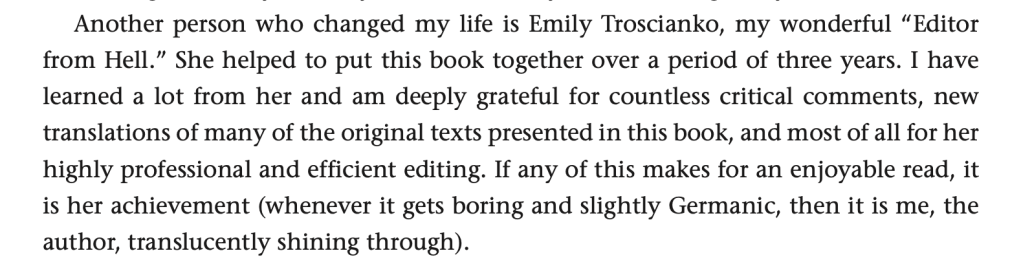
Because I love working with language as well as with humans, I occasionally offer paid editing work. My longest collaboration has been with philosopher Thomas Metzinger. Between 2021 and 2023 we worked on his book The Elephant and the Blind. The Experience of Pure Consciousness: Philosophy, Science, and 500+ Experiential Reports (MIT Press, 2024). I share with permission this acknowledgement from the book:
You can also see the Courses page for more on how clients have responded to the work/life/writing events and courses I run.
And if you’d like to check out my privacy policy on how I use and protect your data if you work with me, it’s here (version 1.11, February 2025).
Last thoughts
In the end, I would invite you to ask yourself: Am I going to wait for things to magically feel better? Am I going to pin everything on graduation, on promotion, on tenure, on getting some miraculous job offer, on meeting the perfect partner or moving house or my children moving out, on really getting everything on my to-do list crossed off next week—after which I’ll start giving time to the things I really care about and life will finally begin? Or am I going to accept that my life is flowing by and that if I don’t get it good now, there’s no particular reason to believe that I ever will?
I don’t mind whether you work with me or you do some other good decisive stuff to get your life feeling better. I just mind that you do something!
If you’d like to know more about my fees, availability, and/or methods, or to book your free 30-minute discovery call, please get in touch via the contact form or by email at emily [at] troscianko.com. Or if you prefer to join my waiting list directly, you can do so by completing the short form here.
 Emily T. Troscianko